I design, analyze, and test structures and mechanical systems, from first-principles load analysis and CAD (SolidWorks, Fusion 360) to vibration analysis, controls, and wind tunnel experiments (MATLAB, LabVIEW). Looking for mechanical design, structural analysis, and test engineering roles, including advanced air mobility, autonomous delivery systems, and launch vehicles.
B.S. Aerospace Engineering, 2026 · Department of Mechanical and Aerospace Engineering, University of California San Diego
Experience
Where I've worked and studied
Teaching, hands-on vehicle design, and my degree.
MAR 2026 – JUN 2026
Course Reader, MAE 104: Aerodynamics
University of California San Diego
Evaluated work from 82 upper-division students on flow physics, performance, and computational methods; gave written feedback.
SEP 2023 – SEP 2024
Mechanical Engineer, Triton Solar Car
University of California San Diego
Designed and assembled the driver pedal assembly for a 450 lb single-seat solar race car using first-principles load analysis for reliable force transfer.
SEP 2022 – JUN 2026
B.S. Aerospace Engineering
Department of Mechanical and Aerospace Engineering, University of California San Diego · Specialization: Astrodynamics & Space Applications
Each project links to its write-up. Reports open right here on the page.
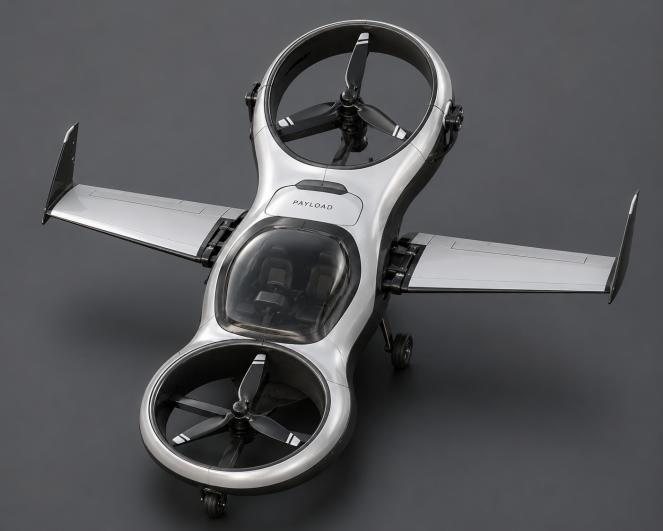
Concept render
MATLAB · OpenVSP/VSPAero · SolidWorks · Jan – Jun 2026
WHOVER: Winged Hovering Electric Rotorcraft
Defined the structure of a 460 kg single-seat eVTOL: aluminum frame (spars, ribs, landing struts) with CFRP shell (fuselage, rotor ducts, ailerons), benchmarked against Joby S4 and Archer Midnight.
Closed a 35 kWh mission energy budget with a 6.5 kWh (19%) reserve by sizing two tilting 1.7 m rotors with momentum theory across hover, climb, transition, and cruise.
Justified a fixed-wing hybrid over multirotor (wings carry at least 40% of cruise lift) and held predicted noise to 70.8 dB at 300 ft with owl-inspired serrations and tip winglets.
460 kg MTOW35 kWh70.8 dB
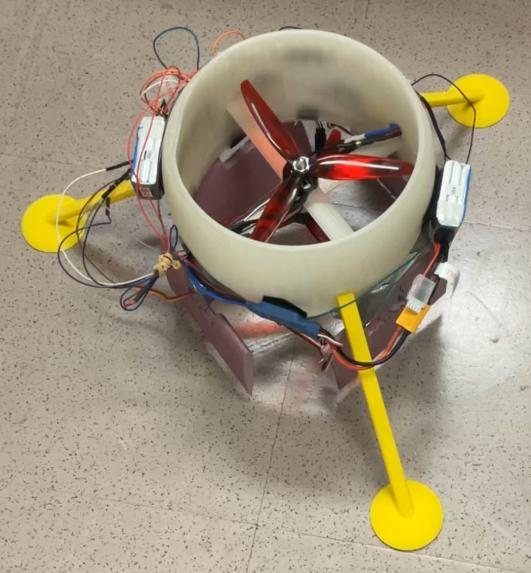
As built
Test stand · IMU · Raspberry Pi Pico · MAE 155B
Ducted Coaxial PAV: Propulsion & Attitude Control
Verified propulsion by measuring 4.3 N thrust per rotor near 10,000 RPM at over 60 W (matching the 4.4 N manufacturer spec) on a test stand with 7-in propellers and 2300 KV motors.
Quantified vehicle inertia (Ixx, Iyy, Izz = 0.0057, 0.0055, 0.0102 kg·m²) with swing and bifilar pendulum tests; traced the mass overrun to wiring, adhesive, and mounting hardware.
Lifted off several inches at about 95% of available power using an IMU/Pico closed-loop attitude controller driving duct vanes.
4.3 N / rotor0.8 kg~95% power
MATLAB · Python · 2025
Wing & Spar Structural Analysis Tool
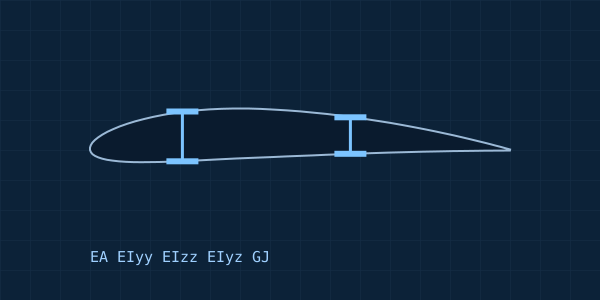
Built a MATLAB tool that computes cross-section stiffness (EA, EIyy, EIzz, EIyz, GJ) for single-cell wings and spars using thin-wall beam theory.
Cut spar mass 80.7% (62.7 to 12.1 lb) and wing mass 88.2% in an aluminum-to-CFRP trade study across five critical V-n load cases.
MATLAB · LabVIEW · MAE 175A
Wind Tunnel Testing: Clark Y-14 Airfoil
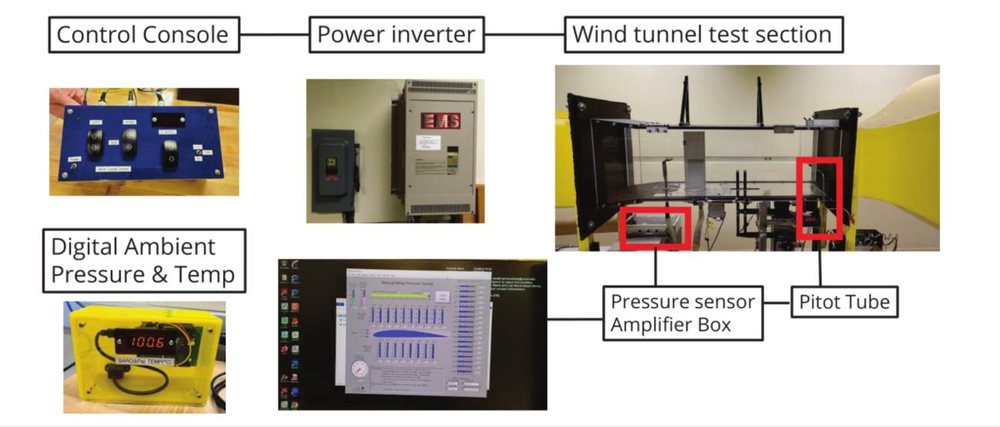
Calibrated fan power to airspeed with under 0.004% velocity uncertainty using a Pitot-static probe and weighted regression.
Measured lift, drag, and moment at 20–50 m/s (Re about 50,000–120,000) with pressure taps, a wake-survey rake, and a sting balance; the three methods agreed within 2σ.
Found stall onset shifting from 6° to 12° as speed rose, and center of pressure moving from 0.35c to 0.25c.
MATLAB · Accelerometers · Digilent AD2 · MAE 175A
Structural Vibration & Modal Analysis
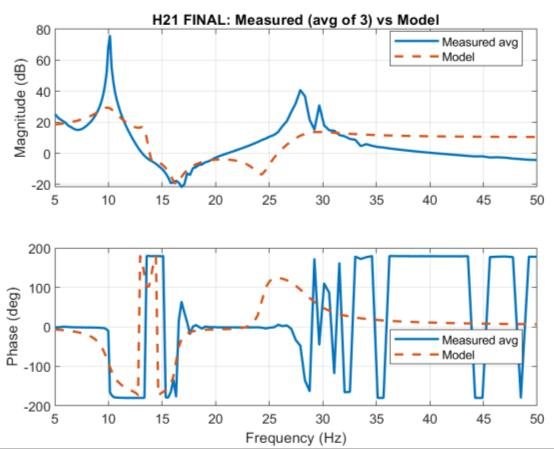
Characterized three modes (10, 17.3, 28 Hz) of a 3-story shear building, with floor amplification ratios and phase lags from FFT, PSD, and the Hilbert transform.
Derived H21 and H31 transfer functions with a 0.073 damping estimate, validated against Bode plots averaged over three trials.
On a rotor blade, measured a 179° root-to-tip phase reversal and 1.3× mid-span amplification, repeatable across three trials.
MATLAB · Simulink · MAE 175A
Multivariable Control: 2-DOF Helicopter
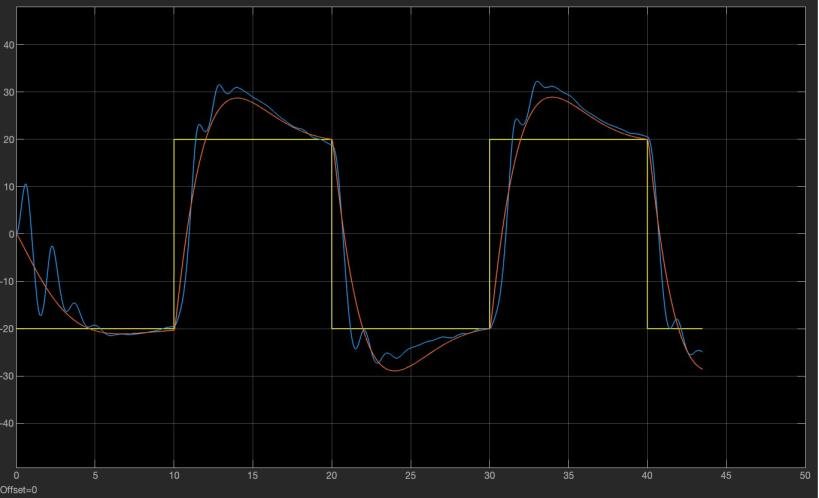
Modeled a coupled pitch/yaw helicopter as a first-order MIMO system; verified PID loops with Nyquist and Bode margins.
Tracked ±5° pitch and ±20° yaw references with a 6-state LQR and decoupling pre-compensator, then traced residual oscillation to a loose stand, slip-ring friction, and wall downwash.